

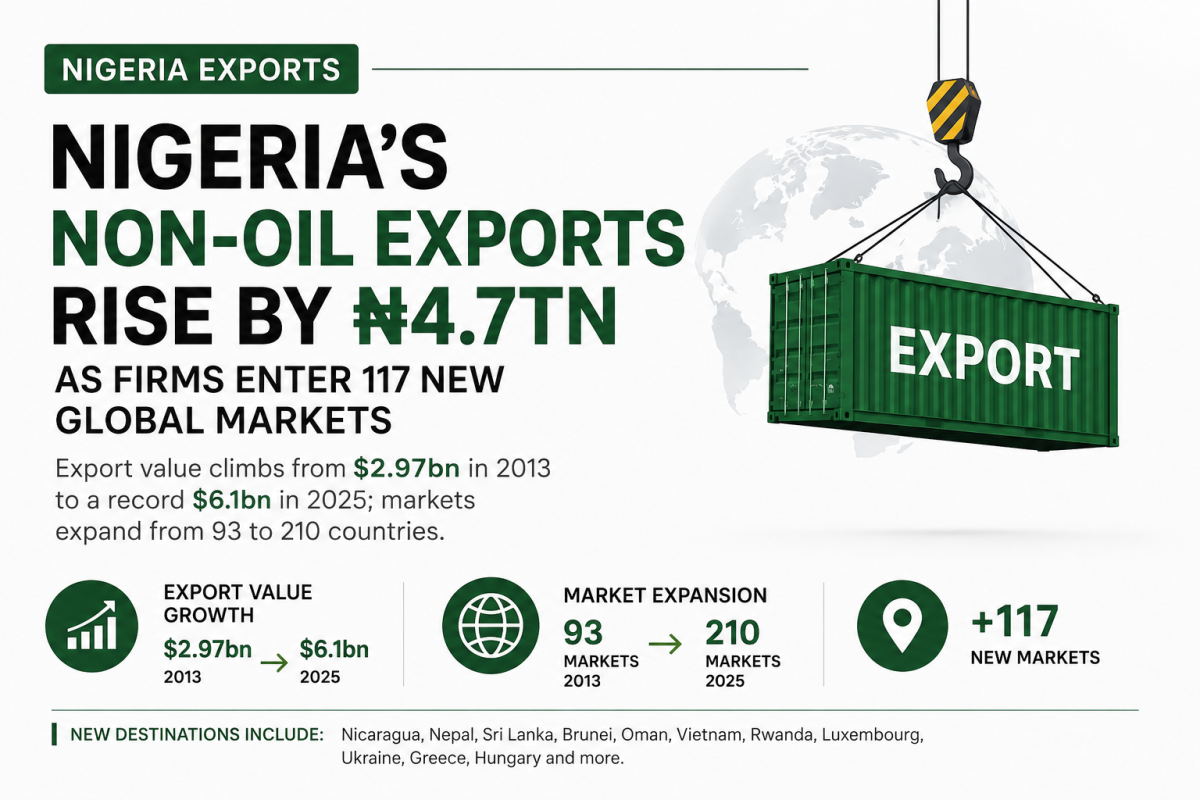
Export value climbed from $2.97bn in 2013 to a record $6.1bn in 2025, as Nigerian businesses expanded their presence across 210 international markets.
Nigeria’s non-oil export sector has recorded a major expansion, with export earnings rising by about ₦4.7 trillion between 2013 and 2025 as Nigerian businesses gained access to 117 additional international markets.
Data from the Nigerian Export Promotion Council (NEPC) showed that non-oil exports increased from $2.97 billion in 2013 to $6.1 billion in 2025, representing an increase of $3.13 billion over the 12-year period.
The expansion also saw Nigeria’s export market reach grow from 93 countries to 210 markets, giving Nigerian products access to 117 new destinations.
Among the newer markets identified are Nicaragua, Nepal, Sri Lanka, Brunei, Oman, Vietnam, Rwanda, Luxembourg, Ukraine, Greece and Hungary.
The development forms part of Nigeria’s efforts to diversify its economy away from dependence on crude oil by promoting non-oil products, processing and value addition.
The NEPC has identified export diversification and increased processing of raw materials as important factors behind the growth.
The African Continental Free Trade Area (AfCFTA) and the ECOWAS Trade Liberalisation Scheme (ETLS) have also provided Nigerian businesses with opportunities to access wider regional and continental markets.
Beyond the wider market reach, recent figures from the Nigeria Customs Service indicate continued growth in export activity.
The Lilypond Export Command processed exports valued at $792.57 million in the second quarter of 2026, representing a 24.35 per cent increase from the $599.60 million recorded during the corresponding period in 2025.
Agricultural exports accounted for $422.09 million of the Lilypond Command’s Q2 2026 export value, while manufactured exports also recorded significant growth.
However, exporters continue to face challenges, including high energy costs, limited access to affordable financing, inadequate infrastructure and bottlenecks affecting trade logistics.
The latest figures nevertheless point to a growing contribution from non-oil products as Nigeria seeks to strengthen its export base, increase foreign-exchange earnings and reduce its dependence on crude oil.
The Federal Government and export-sector stakeholders are expected to continue focusing on value addition, market expansion and improved trade infrastructure to sustain the growth.






Comments (0)
Leave a Comment
No comments yet. Be the first to share your thoughts.