

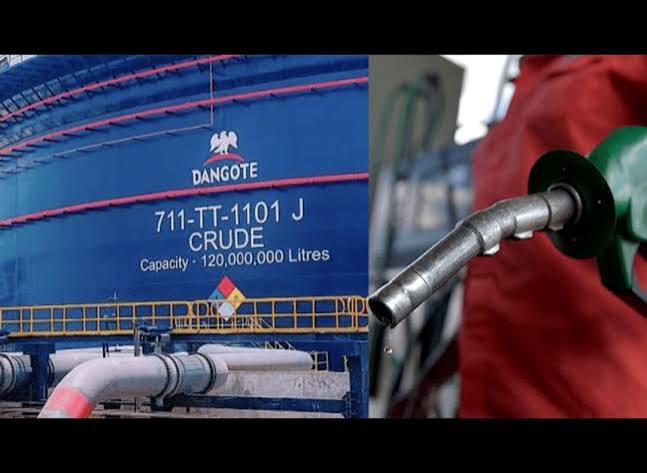
Dangote Refinery’s decision to price petrol, diesel and aviation fuel in United States dollars has shifted the basis on which Nigerians will experience fuel costs, according to economic policy analyst Vincent Nwanma.
The refinery announced the change on 13 July, fixing its ex-depot petrol price at $0.779 per litre, diesel at $1.087 per litre and aviation fuel at $0.942 per litre. It simultaneously withdrew all previously issued naira-denominated invoices. The move ends the naira-based pricing that followed the Federal Government’s naira-for-crude initiative introduced in October 2024.
Nwanma described the decision as a standard financial hedge against currency mismatch rather than an attempt to force Nigerians to pay in dollars. The refinery incurs a growing share of its crude oil costs in dollars. Selling products in naira while the local currency fluctuates exposes it to losses when the naira depreciates.
“It means we are now paying the naira equivalent of the international price of petroleum products. The prices could change at any time depending on the exchange rate and global pricing,” Nwanma told The ICIR.
Consumers will continue to pay at the pump in naira. However, the naira amount will now track both international product prices and the naira-dollar exchange rate more closely. This is expected to produce more frequent adjustments than under the previous arrangement.
The analyst warned that the effects will extend beyond motorists. Commercial transporters, manufacturers and households are likely to face higher and less predictable costs, with knock-on impacts on transport fares, food prices and other goods that rely on petroleum products.
Because Dangote Refinery is Nigeria’s dominant supplier of refined fuel, its pricing decisions carry significant weight across the downstream market. Nwanma said the development places renewed pressure on the Central Bank of Nigeria and economic managers to maintain exchange-rate stability. A weaker naira will raise the naira cost of fuel; a stronger naira could ease it.
He identified increased domestic productivity, stronger exports and higher foreign-exchange reserves as the structural measures required to limit future shocks. Without progress on those fronts, the new pricing regime is likely to transmit global oil and currency volatility more directly into Nigerian household and business costs.
The shift also highlights the incomplete realisation of the naira-for-crude policy. Implementation difficulties reportedly caused a larger share of crude supplies to revert to dollar-denominated transactions, undermining the original goal of insulating domestic fuel prices from exchange-rate pressure.





Comments (0)
Leave a Comment
No comments yet. Be the first to share your thoughts.