

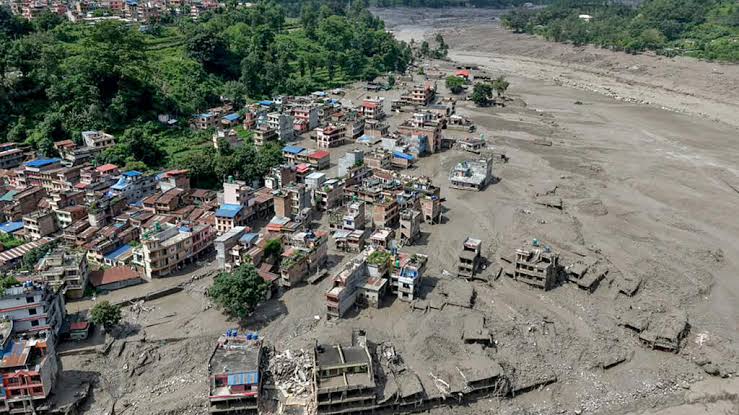
At least 168 people have been reported dead and more than 1,300 remain missing after catastrophic floods and mudslides swept through communities along the Nepal-China border, triggering a large-scale search and rescue operation.
The disaster followed the collapse of glacial rock and ice in the Himalayan region on Wednesday, sending a powerful surge of mud, debris and water through settlements, roads and border communities.
Nepalese authorities said on Thursday that 165 people had died in Nepal, while Chinese authorities reported at least three deaths in Tibet.
More than 800 people were reported missing on the Nepalese side of the border, while another 558 were unaccounted for in Tibet.
The missing include hundreds of foreign tourists and pilgrims who were travelling through the mountainous region.
Among those reported missing are citizens of India, the United States, Australia, Britain, Canada and several other countries.
Rescue teams resumed operations on Thursday, using helicopters to reach communities cut off after roads, bridges and other infrastructure were destroyed.
More than 5,000 police and military personnel have been deployed to the affected areas in Nepal.
Authorities said at least 125 people had been rescued on Thursday, including foreign nationals.
Helicopters have also been delivering tents, food and emergency supplies to communities that remain inaccessible by road.
Some of the worst destruction has been recorded in Nepal's Nuwakot and Rasuwa districts and around Gyirong County in Tibet.
Images from the affected areas showed buildings buried under thick mud, vehicles trapped in debris and sections of roads and bridges washed away.
Chinese authorities have also identified a barrier lake upstream from the affected border crossing, raising concern about possible further flooding or landslides.
The disaster was initially linked to a possible earthquake after seismic activity was detected in the region.
However, the United States Geological Survey later concluded that the seismic signal was generated by the collapse of glacial rock and ice rather than an earthquake.
Climate researchers said an avalanche from a glacier likely blocked part of the Lhende Khola river system before releasing a sudden and destructive surge downstream.
Water levels along part of the Trishuli River reportedly rose by several metres within about half an hour.
Many of those travelling through the region were pilgrims heading towards Mount Kailash and Lake Mansarovar in Tibet, sites considered sacred by Hindus, Buddhists and followers of other religious traditions.
Nepalese officials warned that the death toll could increase as rescuers reach areas buried beneath mud and debris.
International assistance has also begun arriving.
The United States announced emergency assistance, while United Nations teams and neighbouring countries have offered supplies and support for rescue operations.
Australia said it was urgently trying to establish the whereabouts of at least 34 of its citizens reported missing.
The full scale of the disaster remains unclear because communication networks and transport routes have been severely damaged.
Rescue teams are expected to continue searching throughout Thursday as authorities attempt to reach isolated communities and establish more accurate casualty figures.






Comments (0)
Leave a Comment
No comments yet. Be the first to share your thoughts.