

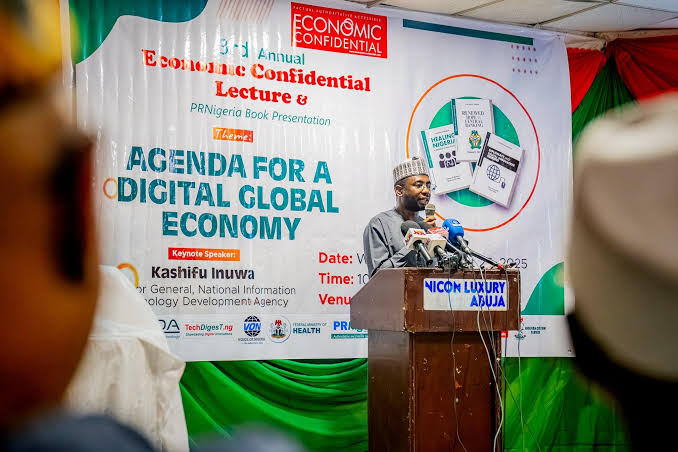
Nigeria is accelerating efforts to position itself as a serious player in Africa’s emerging artificial intelligence economy, which analysts project could generate up to $1 trillion in additional economic value by 2035.
The push comes as the country prepares to host the second edition of GITEX Nigeria from 31 August to 3 September, an event expected to bring together government officials, technology companies, investors and startups in Abuja and Lagos. Organisers and officials frame the gathering as a platform to attract capital and partnerships for the next phase of Nigeria’s digital development.
At the centre of the strategy is a shift in mindset: moving Nigeria from a market that largely consumes technology developed elsewhere to one capable of producing and exporting AI solutions. The country already hosts one of Africa’s largest technology ecosystems and a large youth population. The challenge, according to policymakers, is converting that potential into businesses, jobs and exportable technology.
In early August, the National Information Technology Development Agency (NITDA) signed key regulatory documents under Nigeria’s National Sovereign Cloud Initiative. The instruments include the National Cloud Computing Guideline, the National Cloud Technical Guideline, and the National Digital Infrastructure Assurance Framework.
According to NITDA, the framework is designed to create a structured national approach to cloud adoption, digital sovereignty and infrastructure investment. The agency aims to position Nigeria as a regional hub for cloud services, data centres and AI infrastructure. A Sovereign Cloud Governance Committee is being established to provide oversight, with a national digital regulatory platform expected to become operational later in 2026 for the certification of cloud and digital infrastructure providers.
This focus on sovereign cloud reflects growing global concern about data control, security and the location of critical computing resources. For Nigeria, it is also a practical step toward supporting local AI development that requires reliable, high-performance computing capacity.
Beyond infrastructure, the government has pointed to several initiatives launched over the past two years. These include the National AI Strategy, the National AI Trust, the AI Collective, the Nigeria AI Scaling Hub, the 3 Million Technical Talent (3MTT) programme, and Project BRIDGE, which is expanding the country’s fibre-optic backbone.
Minister of Communications, Innovation and Digital Economy Bosun Tijani has repeatedly emphasised the need for locally relevant AI models. Global large language models, he and other stakeholders argue, often fail to reflect African languages, cultural contexts and practical use cases. Efforts such as Nigeria’s N-ATLAS language model are seen as early attempts to address that gap.
The International Monetary Fund has also recognised Nigeria as one of Africa’s leading AI economies, citing progress in policy development and institutional readiness rather than raw infrastructure alone. While the ranking is encouraging, officials acknowledge that deployment and commercialisation still lag behind ambition.
GITEX Nigeria will open with a Government Leadership and AI Summit in Abuja before moving to Lagos for the Tech Expo, Future Economy Conference and Startup Festival. A dedicated finance and digital assets event, FDX Nigeria, will also debut.
For all the policy announcements and international recognition, the real test remains execution. Building data centres, training large numbers of engineers, creating commercially viable AI products, and ensuring reliable power and connectivity are complex, long-term tasks. Capital is selective, and global competition for AI talent and investment is intense.
Still, the direction of travel is clear. Nigeria is no longer content to remain primarily a consumer of artificial intelligence tools developed in other regions. Through a combination of regulation, infrastructure investment, talent programmes and international visibility, the country is attempting to claim a meaningful stake in what could become one of the most significant technological and economic shifts of the next decade.
Whether that ambition translates into scalable companies, exportable technology and broad-based opportunity will depend on sustained follow-through long after the conferences end.


Comments (0)
Leave a Comment
No comments yet. Be the first to share your thoughts.