

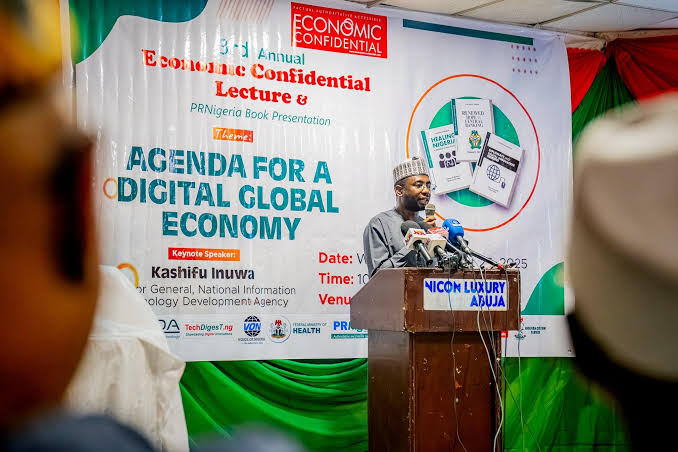
The Director-General of the National Information Technology Development Agency, Kashifu Inuwa Abdullahi, has urged the Central Bank of Nigeria to prepare for a future in which banking services increasingly operate within everyday digital platforms rather than through conventional bank branches and applications.
Inuwa made the call during the CBN Committee of Departmental Directors Retreat in Lagos, where he argued that Nigeria’s financial regulatory framework must evolve alongside rapid changes in fintech, artificial intelligence, telecommunications and cloud computing.
He described the emerging model as “invisible banking”, where financial services are integrated into activities such as shopping, transportation and digital payments, allowing customers to access banking functions without necessarily interacting directly with a traditional bank.
According to Inuwa, the shift means regulators can no longer focus solely on licensed banks because modern financial services depend on a wider network that includes fintech companies, telecommunications operators, cloud providers and national payment switches.
A technical failure or cyber incident affecting one of those non-bank providers could therefore disrupt services offered by regulated financial institutions, he said.
Inuwa called for what he described as a broader architecture of financial supervision capable of assessing risks across the entire digital ecosystem.
He also urged the CBN to expand the use of artificial intelligence and other technologies in its regulatory work, including anomaly detection, network analysis, early-warning systems and AI-assisted monitoring.
The NITDA chief drew a distinction between simply digitising existing processes and undertaking full digital transformation.
Putting traditional procedures online, he argued, is not enough if institutions do not also develop the capacity to adapt continuously as technology, consumer behaviour and emerging risks change.
His comments come as Nigeria’s banking and financial services industry becomes increasingly dependent on mobile applications, fintech platforms and digital payment infrastructure.
For millions of Nigerians, transactions that once required visits to bank branches can now be completed through smartphones, point-of-sale terminals and third-party financial platforms.
That convenience has also created new areas of vulnerability.
Inuwa said regulators should pay attention not only to preventing cyberattacks but also to digital operational resilience, including the ability of financial institutions and their technology partners to continue functioning or recover quickly when systems are disrupted.
He linked resilience to what he called digital sovereignty, including Nigeria’s ability to retain adequate control over critical data, infrastructure and digital skills.
Inuwa also commended the CBN for aligning with the Federal Government’s sovereign-cloud direction on the local residency of financial transaction data.
His latest remarks are consistent with a broader position NITDA has taken on the future of Nigeria’s financial sector.
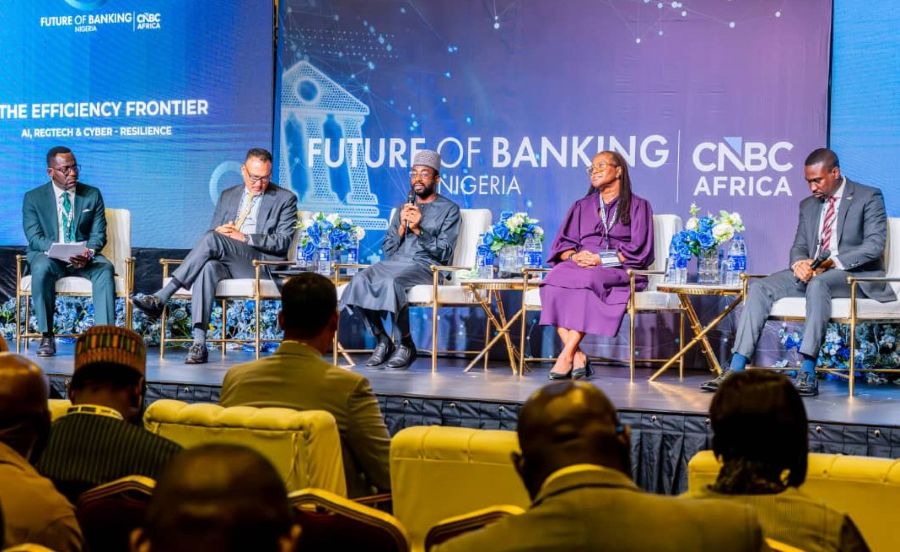
At a recent Future of Banking Nigeria Summit, Inuwa said artificial intelligence, regulatory technology and cyber resilience would become increasingly important to sustaining confidence in the banking system as financial services become more digital.
He argued that the next stage of banking development would depend not only on institutions having sufficient capital, but also on their capacity to protect digital systems, manage emerging technological risks and maintain public trust.
For the CBN, the shift presents a regulatory challenge: protecting consumers and financial stability in an ecosystem where a banking transaction may begin and end on a platform that is not itself a bank.
As embedded finance expands, the boundaries separating banks, fintech companies, telecommunications providers and technology infrastructure companies are likely to become less visible to consumers.
Inuwa said Nigeria’s regulatory capability must be able to understand those connections, anticipate risks and protect the resilience of the financial system as the transformation accelerates.




Comments (0)
Leave a Comment
No comments yet. Be the first to share your thoughts.